Anxiety is not confined to one age: childhood and adult symptoms can begin at different life stages, and depression often appears alongside it
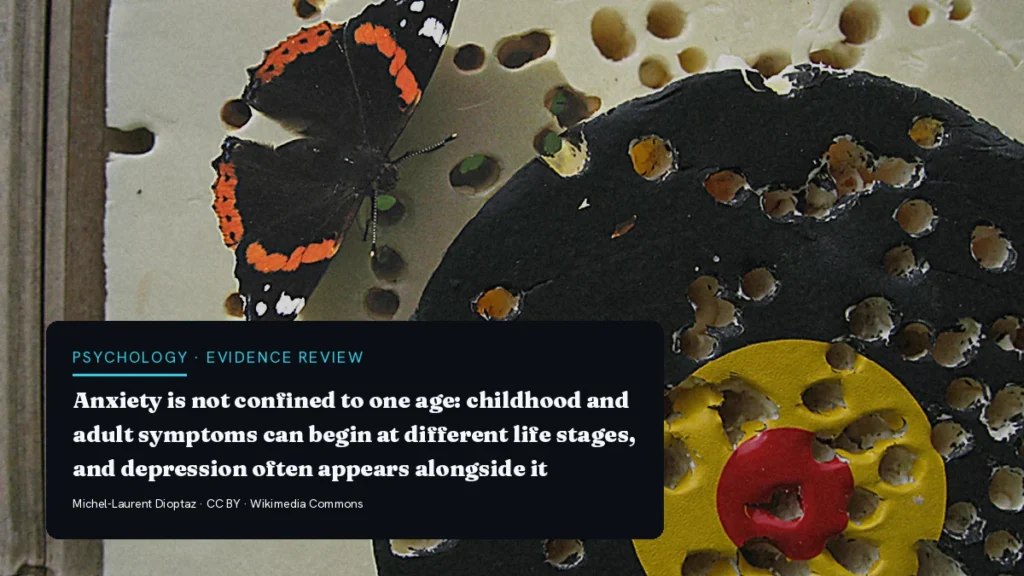
You finish the phone call, replay one sentence, and feel the alarm rise again.
The smoke-alarm picture helps explain that rush: anxiety can treat an uncertain signal as urgent, while the research directly measures worry, symptoms, timing, and change.
That picture does not prove that anxiety mistakes toast for fire in every situation. It gives you a way to hold the measured findings together.
A daily 15-minute scheduled worry period reduced overall worry, and slow breathing near 6 breaths per minute raised heart-rate variability and rest-related activity.
So what does the evidence actually support? Anxiety can persist, begin at different life stages, and respond to changes in how attention and bodily arousal are handled.
The rest of this article keeps that answer close to the moment that brought you here.
The cited source list names NIMH, Services Australia, and the DSS, alongside peer-reviewed studies.
Before the sections open, the figures this page stands on — each one carrying its own source.
What the smoke-alarm picture gets right about anxiety
You notice a small change in your body or thoughts, then the danger feeling arrives before you can judge the signal.
The smoke-alarm image captures that lived sequence. It describes urgency arriving around a possible threat. The cited research measures anxiety disorders and worry rather than a literal alarm system.
That distinction matters. A vivid analogy can help name the experience, while the evidence still sets the boundaries of the claim.
For the person lying awake with the same concern, the most useful finding concerns what happens when worry receives a planned place.
A scheduled worry period used stimulus control. A daily period of about 15 minutes reduced overall worry compared with all-day rumination.
The result supports a practical observation about attention. Worry that spreads across the day can change when it receives a defined time.
This does not show that every anxious feeling will shrink on the same schedule. It shows a measured change in overall worry under a specific practice.
The alarm picture therefore works best as a starting point. The stronger answer comes from the exact outcomes researchers tracked.
Why all-day worry feels like a fire that will not clear
One concern follows the reader from breakfast to work, then returns during a quiet moment.
All-day rumination keeps the mind returning to the same possible problem.
The scheduled worry study found less overall worry when that process received a daily period of about 15 minutes.
That finding gives the smoke-alarm comparison a clear limit and a useful detail. The mind can keep checking a signal long after the first check.
In the study, stimulus control changed the timing of worry. The finding did not establish a permanent end to anxiety or a single cause for it.
For the person facing the next wave, timing becomes the decision in front of them. A worry can be written down and reserved for the planned period.
The move keeps the article’s promise grounded.
Anxiety may feel like an alarm that treats every signal as fire, while the measured intervention concerns the spread of worry across the day.
That difference protects the reader from a broad claim. It also gives the reader one concrete behavior tied to the evidence.
Most quizzes flatter or frighten. This one opens with its own error rate, which is exactly why it can be trusted with a hard question.
When anxiety starts can change the question you ask
A teenager who fears being watched may meet anxiety years before an adult develops broad, persistent worry.
Social anxiety disorder has a median onset of about 13 years. Roughly 75% of cases began between ages 8 and 15, and the course tended to remain chronic without treatment.
Generalized anxiety disorder followed a different timing pattern in the US national survey.
Its median age of onset sat near 31 years, the latest among the major anxiety disorders described in that source.
That contrast changes how the smoke-alarm picture should be used. The same word, anxiety, can describe patterns that begin at very different points in life.
The reader’s present moment may carry a long history or a more recent shift. Age of onset alone cannot explain the individual experience.
Still, the findings show why one broad story will not fit every anxious person. Social fear often begins in adolescence, while generalized anxiety disorder commonly starts later.
Both patterns can follow a chronic course. That persistence helps explain why a person may keep searching for a better account of what the alarm means.
Before anyone sells you a staircase, here is the one the evidence actually built — starting at the bottom rung.
How common anxiety is across childhood and adulthood
A child, teenager, or adult may look around and wonder whether the anxious response belongs only to them.
A meta-analysis covering 41 studies across 27 countries found a worldwide prevalence of any anxiety disorder in children and adolescents of 6.5%.
The US National Comorbidity Survey Replication found past-year generalized anxiety disorder prevalence of 2.7% among adults. Lifetime prevalence reached 5.7%.
Those figures describe different groups and time frames. They should not be combined into one personal prediction.
For the reader in the middle of an anxious evening, prevalence does one narrow job. It shows that the experience appears across age groups and countries.
Severity also varied within the adult past-year cases. The source classified 32.3% as serious, 44.6% as moderate, and 23.1% as mild.
The smoke-alarm image can sound universal, yet the measured pattern has important detail. Anxiety differs by age, disorder, severity, and time frame.
That detail keeps the explanation humane. A percentage describes a population pattern, not the meaning of one person’s symptoms.
Whatever this page has stirred, you are not carrying it alone. Pick your age and place; the room will show you your company.
Why anxiety and depression often appear together
The reader who feels anxious and low at the same time may struggle to decide which experience came first.
In a US national sample, about 40% of people with depression also met criteria for an anxiety disorder.
About 52% of people with an anxiety disorder also met criteria for depression.
These findings show frequent co-occurrence. They do not establish that one disorder caused the other in each person.
The overlap adds another reason to avoid a single alarm story. A person may carry anxious worry, depressed mood, or both patterns at once.
For someone reviewing the past week, the useful question concerns the pattern being experienced. Is the central problem worry, low mood, social fear, or a combination?
The evidence supports careful description rather than a forced label. Anxiety’s alarm-like quality can sit beside depression without explaining the whole picture.
This section also returns the reader to the original promise. A smoke alarm may describe the felt urgency, while the research records several distinct clinical patterns.
The question nobody answers straight: how long until it works? Here is the picture, week by honest week, receipts attached.
What slow breathing changes during an anxious moment
Your chest feels busy, your attention narrows, and the next decision seems harder than it did a few minutes earlier.
Research on slow paced breathing near 6 breaths per minute found raised heart-rate variability and increased rest-related, or parasympathetic, activity.
That result measures changes linked with breathing pace. It does not prove that breathing removes the source of anxiety or settles every form of worry.
The finding still gives the reader a physical move. Slow the breathing toward the studied pace and notice what changes in the body.
For the person watching the alarm rise, this creates a pause between bodily activation and the next thought.
Breathing belongs beside the scheduled worry finding because the studies address different parts of the anxious experience. One changes when worry receives attention.
The other tracks bodily measures during slow breathing.
The evidence stays modest and useful. A slower pace can change heart-rate variability and rest-related activity during the exercise.
Here are the figures the rest of this piece leans on — each one quoted, each one receipted.
Follow any branch down and you land on a source — quoted exactly, receipt in hand.
Words and moves for the next alarm
The reader who keeps checking the same worry needs language that describes the moment clearly and a physical action that can begin today.
Start with the thought that arrives first. Say, “Something feels dangerous.” Then try, “I have one worry to record, and I will give it a planned period later.”
A parent hearing a child fear social attention can say, “You should stop worrying.” A clearer line is, “You noticed fear when people looked at you; write that moment down.”
The first pair names a broad alarm. The second gives worry a time and a concrete observation.
A student replaying a conversation might think, “I ruined everything.”
A stronger line to speak aloud is, “I am replaying one conversation; I will place the concern in the scheduled worry period.”
Each stronger sentence stays close to the evidence. It names worry, sets a planned period, or records the situation without claiming certainty.
The office worker who feels the body accelerate during a difficult task can sit down and slow the breath toward 6 breaths per minute.
The student carrying social fear can write the triggering moment on one line and return to the present task.
The parent listening to a child’s fear can record the exact social situation before offering an opinion.
Those three roles face different moments. Each has one physical next action: slow the breath, write the moment, or record the situation.
Seven phrases below carry the article’s central answer: the alarm feeling can be real, while the measured findings concern worry, timing, prevalence, persistence, and bodily change.
Use the stronger wording as a description, not a verdict. It can make the next step more specific without pretending that one exercise explains the whole person.
What the evidence can and cannot tell you today
After another anxious episode, the reader may want one sentence that settles the entire question.
The evidence supports a narrower answer. Anxiety can feel urgent around uncertain signals, and worry can spread across the day.
A daily scheduled worry period of about 15 minutes reduced overall worry in the cited study.
Slow paced breathing near 6 breaths per minute changed heart-rate variability and rest-related activity.
Anxiety disorders also show different prevalence, onset, severity, and overlap with depression. Those patterns make the experience real without making every case identical.
The smoke-alarm image remains a brief guide to the feeling. It cannot replace the measured findings or explain why one reader’s anxiety began.
For the person deciding what to do with the next worry, two evidence-linked moves stand out. Reserve a daily worry period and slow the breath toward the studied pace.
Keep the claim precise as you watch what happens. The research gives a way to examine worry and bodily arousal, then return to the wider pattern in your own life.
That is the clearest answer to the promise that brought you here.
Anxiety may feel like an alarm unable to sort toast from fire, while the strongest evidence shows specific changes in worry timing and breathing-related measures.
You have read enough about minds in general. This one maps yours — drawn live from your answers, with a citation under every claim.
Remember the note you left? It has been waiting for you.
What each anxiety finding measured
- Children and adolescents across 27 countries — Any anxiety disorder — 6.5% worldwide prevalence
- US adults — Past-year generalized anxiety disorder — 2.7% prevalence
- US adults — Lifetime generalized anxiety disorder — 5.7% prevalence
- Social anxiety disorder — Median age of onset — about 13 years
- Generalized anxiety disorder — Median age of onset — about 31 years
- People with depression in a US national sample — Also met criteria for an anxiety disorder — about 40%
- People with an anxiety disorder in a US national sample — Also met criteria for depression — about 52%
And if a nerve got touched just now, the help below is real and free, open at any hour.
Before the last word, gather this whole page into a single sentence of your own — the when and the how, decided now.
And to honour the receipts above: here is how this page itself was built, device by device.
If part of your situation reaches past this page, the guides below cover the next step directly.
Two evidence-linked moves
- Choose one daily worry period of about 15 minutes and reserve recurring worries for that period.
- When the body feels activated, slow the breathing toward 6 breaths per minute.
- Notice whether the worry takes less of the day or whether the body shows a different response during slow breathing.
This is general information about the mind, not therapy or a diagnosis. If things feel hard, please consult a professional. In a crisis, reach a free, confidential crisis hotline right away; findahelpline.com lists one for your country.
This article was last reviewed on August 21, 2026. Psychology is a living science — where findings are contested or have failed to replicate, we say so in the text.