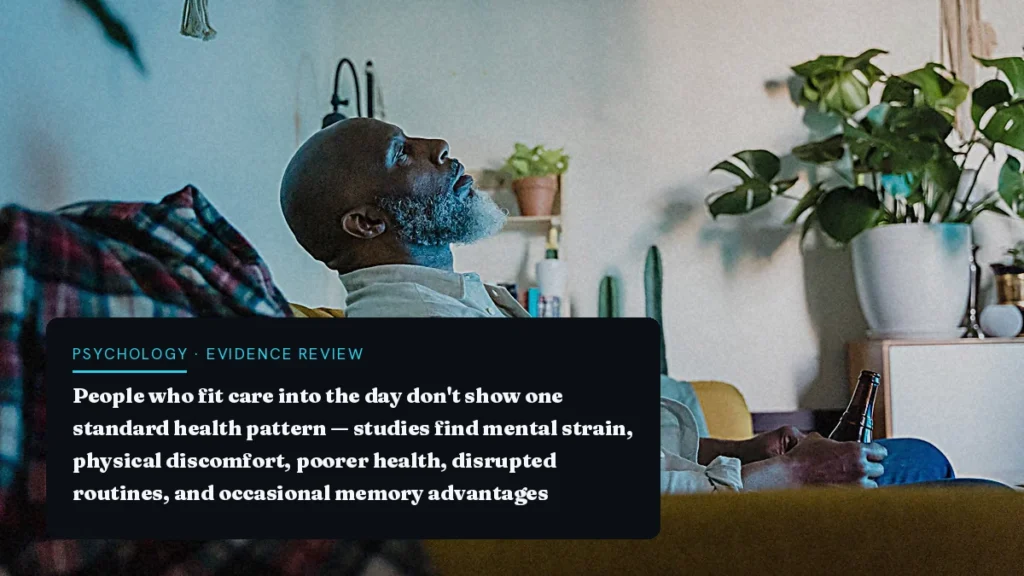
People who fit care into the day don’t show one standard health pattern — studies find mental strain, physical discomfort, poorer health, disrupted routines, and occasional memory advantages
You are fitting care into the day and wondering what the numbers say about your health.
The research record, alongside public names such as Services Australia and the DSS, gives a mixed answer: informal caregiving links with mental strain, poorer health, pain, and disrupted routines, while some studies also find better memory or lower mortality among caregivers.
Does caregiving itself cause these effects? The studies do not support one simple answer.
They measure links between care and health across different illnesses, ages, countries, care hours, and kinds of support.
What health effects appear most often in informal caregivers?
Your household may feel the effects through mood, energy, pain, memory, work, or daily routines. The studies measure several of these areas rather than one single caregiving health outcome.
Mental health shows a repeated link with care intensity. An Australian longitudinal study found differences in mental and general health between carers and non-carers.
Another population study linked informal caregiving with self-reported poor health. Its odds ratio was 1.100, with a 95% confidence interval from 1.096 to 1.103.
Physical strain also appears in the record. Informal caregivers reported high levels of musculoskeletal discomfort in a study focused on physical demand and care tasks.
Pain formed part of the picture for older family caregivers. In one cohort, 56.7% of caregivers reported pain.
The pattern changes by setting and group. A study in India found that nearly 29% of informal caregivers reported depressive symptoms, while 11% reported poor self-rated health.
These figures describe study groups. They do not predict what will happen to one household. They do show why health effects deserve more than a single label.
Across the seven sections in this article, the numbers point to a mixed record. Intensity, time, illness, support, and the type of health measure all matter.
How does the amount of care shape health?
Your care day can expand until ordinary health tasks become harder to protect. The strongest findings often appear when researchers separate lighter care from intensive care.
A 2025 study found that moderate and intensive caregiving reduced a health-related quality-of-life measure. The reported coefficients were β = -0.0035 and β = -0.0074.
Those coefficients describe a link in that study. They do not convert into a personal score or forecast for your household.
Weekly hours also matter in some research.
Women who gave 36 or more weekly hours of care to a disabled spouse were almost 6 times more likely to report depressive or anxious symptoms than noncaregivers.
The study reported a multivariate odds ratio of 5.6. Its 95% confidence interval ran from 3.8 to 8.3.
Other findings show how care demand can shift quickly. During COVID-19 lockdowns, co-residing caregivers provided about 7 more days of daily living support per month.
Visiting caregivers increased their care by 1.9 days. The same study reported a standard deviation of ± 11.5 for that change.
For the reader weighing a busy care schedule, this distinction matters.
A care role can change in frequency, duration, and physical demand, and each change can affect the health measure researchers track.
Here are the figures the rest of this piece leans on — each one quoted, each one receipted.
What does caregiving research show about parents of adults with autism?
Your question may come from a home where care includes repeated prompts, redirection, or support with behavior. That daily work can carry a measurable burden for parents.
The key study examined daily living skills in adults with autism and parental caregiver burden.
About half of the adults, 50.3%, required minimal prompting, direction, or redirection for their behavior.
Only 4.4% had typical age-appropriate adult behavior. The study also found that 11% of parents reported serious challenging behaviors.
This finding gives the clearest answer to the reader’s central concern.
Caregiving health effects can track the demands placed on the parent’s day, especially when support and behavior needs remain high.
The result does not say that every parent will develop poor health. It records how daily living needs and caregiver burden appeared together in that study.
That difference matters when reading headlines about caregiving. A measured burden describes an experience reported by caregivers. It does not prove that one feature alone caused every health change.
Your household may also include care that feels meaningful.
A study of caregivers of people with metastatic cancer found four groups, including groups with low burden and moderate or high esteem.
The same study found groups with high burden and low or high esteem. Burden and positive meaning can appear in the same caregiving life.
Every section above has roots. Here they are, drawn as a tree — leaves quoted, receipts attached.
Why do some studies find better memory among caregivers?
Your concern about caregiving may include forgetfulness, yet the research on cognition does not point in one direction. Some studies recorded more cognitive complaints, while others found better performance.
A China study found a positive association between caregiving and cognitive functioning. The reported coefficient was β = 0.249, with p < 0.001.
A separate study from the Midlife in the United States project found better episodic memory among people who provided care at both study waves.
The reported coefficient for episodic memory was b = .24. The standard error was .10, and p = .013.
That study did not find a significant link with executive function. The reported coefficient was b = -.06, with a standard error of .05 and p = .246.
Another study found more cognitive complaints among informal caregivers. Its odds ratio was 1.44, with a 95% confidence interval from 1.21 to 1.73.
These results can coexist because the studies measured different outcomes. Cognitive complaints describe how people experience their thinking. Memory tests and executive-function tests measure specific performance areas.
Your own experience may also change with sleep, stress, illness, and care demands.
The cited findings support careful comparison of measures, rather than a single claim about caregiving and the brain.
You have read enough about minds in general. This one maps yours — drawn live from your answers, with a citation under every claim.
What happens to mental health during intense or disrupted care?
Your household may notice mental strain when care takes over work, rest, social time, or family plans. Several studies connect intense care with worse mental health.
A census-based longitudinal study found that intense caregiving was associated with worse mental health.
The adjusted odds ratio was 1.15, with a 95% confidence interval from 1.12 to 1.18.
Care during a crisis can feel harder even when the number of caregivers changes little. In Singapore, 36.1% of informal caregivers said care became harder during lockdown.
Austria provides a useful caution about simple before-and-after claims. The share of people providing informal care was 13% before the pandemic and 14% after its onset.
Care frequency changed in other ways across Europe. During the first phase of the pandemic, personal care for parents increased in almost all countries, while care for children decreased.
Work routines also shifted for some dementia caregivers.
Among one study sample, 59.5% of workers stopped working after lockdown, 17.9% switched to smart-working, and 2.4% reduced their working time.
These findings describe disrupted conditions. They do not show that lockdown created every mental health symptom.
They show that changes in care and work can occur together during a major crisis.
Support may change the size of the link.
One study found that perceived social support reduced the relationship between carer status and psychological distress by 40% for full-time carers and 60% for part-time carers.
Remember the note you left? It has been waiting for you.
How do pain, exercise, and daily health fit together?
Your health can shift through small losses of time for movement, appointments, rest, or ordinary routines. The studies connect caregiving with some of these changes without proving one fixed pathway.
A study of gender differences found that reduced regular exercise partly explained the association between informal caregiving and subjective health.
The share was 11% for health satisfaction and 8% for self-rated health.
Physical tasks can add another layer. Caregivers in a study of musculoskeletal discomfort reported high levels of physical strain and discomfort.
Older family caregivers also reported pain at a notable rate. The cohort recorded pain among 56.7% of caregivers.
Health effects can reach work and social activity as well.
In Malaysia, informal care was associated with female sex, age 36–59 years, and illness reported during the past 2 weeks.
The reported odds ratios were 1.52 for female sex, 1.61 for age 36–59 years, and 1.79 for recent illness.
Those results describe associations within one national survey. They cannot show that caregiving caused the illness or explain every difference between caregivers.
For your household, the useful question is which health measure changed. Pain, exercise, self-rated health, mental health, and work status answer different questions.
And if a nerve got touched just now, the help below is real and free, open at any hour.
Before the last word, gather this whole page into a single sentence of your own — the when and the how, decided now.
And to honour the receipts above: here is how this page itself was built, device by device.
If part of your situation reaches past this page, the guides below cover the next step directly.
What should you take from the caregiving health numbers?
Your situation deserves a reading that holds strain and meaning together.
The evidence shows real health differences in some caregiver groups, alongside findings that point to cognitive or emotional benefits in others.
Informal caregiving was associated with a 16% lower combined effect on all-cause mortality in a meta-analysis of longitudinal population studies.
That result does not cancel findings on distress, pain, poor self-rated health, or reduced quality of life. Mortality, mood, pain, cognition, and life satisfaction are separate outcomes.
Caregiving relationships also shape the experience. A qualitative dementia study identified changed life, commitment, responsibility and duty, and support as four major categories.
Another review found common caregiving difficulties across cultural and ethnic groups. The shared experience did not erase differences in care needs or available support.
Research on service support offers one more useful pattern. Generous formal long-term care resources reduced the well-being gap between caregivers and non-caregivers in one European study.
Care intensity can also affect family finances and routines, though those outcomes are separate from direct health measures.
A cancer caregiver study reported disrupted schedules for 55% of caregivers, health problems for 25%, and a lack of family support for 27%.
For the reader who arrived seeking a number, the answer is a range of measured effects. The clearest risks appear around intense care, poor support, physical demand, and disrupted routines.
The clearest caution is equally important. These studies do not provide a personal diagnosis, and they do not prove that caregiving alone caused one household’s health change.
Read the result that matches the measure in question. Then keep the difference between association, reported experience, and tested performance in view.
This is general information about the mind, not therapy or a diagnosis. If things feel hard, please consult a professional. In a crisis, reach a free, confidential crisis hotline right away; findahelpline.com lists one for your country.
This article was last reviewed on August 29, 2026. Psychology is a living science — where findings are contested or have failed to replicate, we say so in the text.