Health Psychology
People who knowingly take a placebo do not share one predictable response — these 15 findings show why reported symptoms may improve even when function, movement, or other outcomes do not
You know the placebo contains no active drug, yet you want to know whether symptoms can still change. The research says they sometimes do, ...
If you wonder whether knowing about a placebo destroys its effect, the answer isn’t a simple yes or no — these 8 findings show where changes appeared and where the evidence stopped
You see “placebo” on the label and wonder whether any effect can remain once you know. Can a treatment described as a placebo still ...
When sleep loss leaves you flat instead of openly distressed, it isn’t evidence that your emotions escaped untouched — positive feeling can fade before negative mood clearly takes over
You have slept too little, and now anxiety, anger or sadness feels closer to the surface. Sleep deprivation can change emotion as well as ...
People who wake after too little sleep are not necessarily emotionally unstable — the measured changes are more specific than that
You wake after too little sleep and find ordinary feelings harder to place. The answer from the research is seven measured patterns, with more ...
You slow your breathing to change how you feel, but the clearest evidence is not a universal emotional lift — it is HRV during practice and possible improvement in panic symptoms
You slow your breathing for health reasons and wait for your body to respond. The clearest research effects appear in heart-rate measures and panic ...
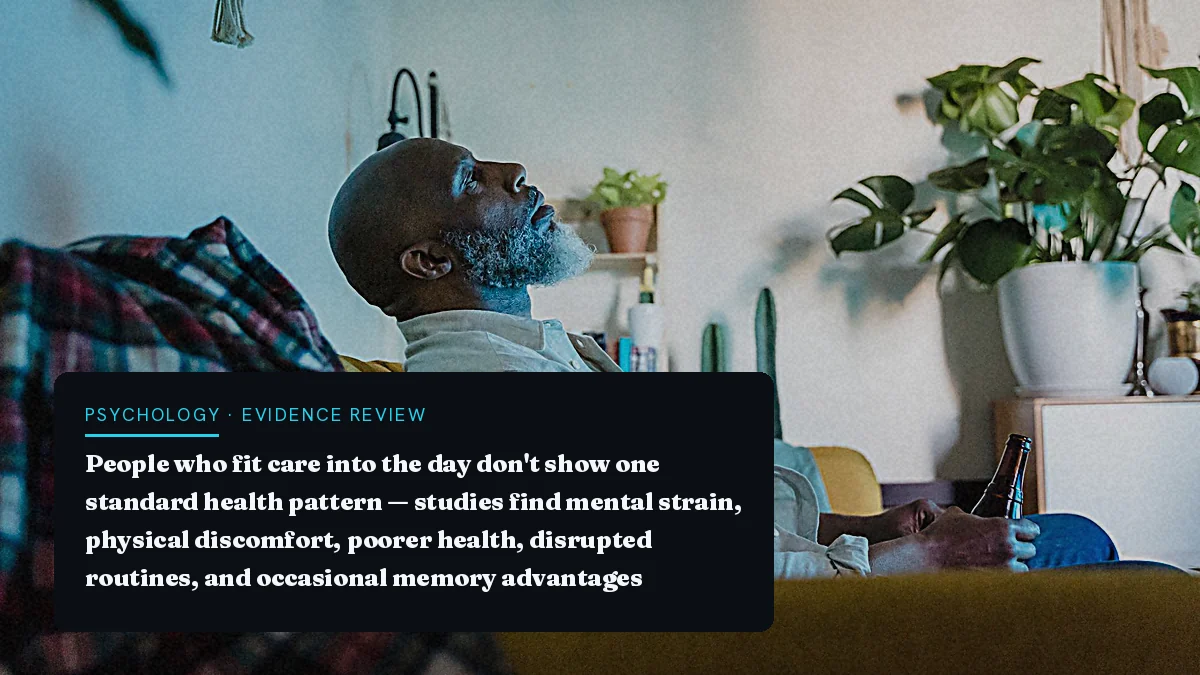
People who fit care into the day don’t show one standard health pattern — studies find mental strain, physical discomfort, poorer health, disrupted routines, and occasional memory advantages
You are fitting care into the day and wondering what the numbers say about your health. The research record, alongside public names such as ...
If you worry an older person is being mistreated, their health problems aren’t proof of one cause — research finds overlapping links with care needs, frailty, loneliness, and emotional symptoms
You are trying to understand whether an older person’s health problems could sit alongside mistreatment, and the research gives a careful answer. Studies connect ...
If you are trying to name a troubling experience, the research does not point to one universal elder mistreatment number—it separates emotional, physical, sexual, financial, and neglect harms.
You are trying to make sense of elder mistreatment numbers after a health concern raised a difficult question at home. The clearest answer is ...
When a family or care situation leaves you unsure whether harm occurred, the answer is not limited to a bruise — research defines elder mistreatment across abuse, neglect and self-neglect
You are trying to decide whether a health problem, a tense relationship or a missed need counts as elder mistreatment. The research answer is ...
Older adults facing mistreatment are not always absent from care — provider visits can overlap with the need for help and protection
You are trying to decide whether a health problem and possible elder mistreatment belong in the same conversation. The research says they often do. ...